Sales Cadence Best Practices: Boost Outreach & Wins

By Mriganka Bhuyan
•Founder at Munch
Remember when your sales strategy was basically throwing spaghetti at the wall to see what sticks? Kind of like every new character introduction in the later seasons of Lost. Those days are over. In today's crowded B2B marketplace, a well-crafted sales cadence isn't just a nice-to-have; it's the critical framework separating a positive reply from being ghosted into oblivion. A great cadence is a choreographed dance, a strategic conversation that unfolds methodically over time and across multiple channels. It systematically guides prospects from "Who are you?" to "Where do I sign?" without feeling pushy, robotic, or like a bad sequel no one asked for.
This guide moves past generic advice and dives deep into the sales cadence best practices that top-performing teams are using to break through the noise right now. We are not just talking about sending more emails. We are unpacking the specific frameworks, psychological triggers, and data-driven tactics you need to build sequences that do more than just get opened, they get responses. Prepare to transform your outreach from a series of random pokes into a structured masterpiece of persuasion and pipeline generation.
You will learn how to:
-
Structure multi-channel sequences for maximum impact.
-
Leverage timing, personalization, and intent data effectively.
-
Align your outreach with the buyer's actual journey.
-
Implement A/B testing and track the metrics that truly matter.
Forget guesswork. This is your playbook for building, optimizing, and scaling sales cadences that consistently book meetings and close deals.
1. The Multi-Channel Cadence Approach
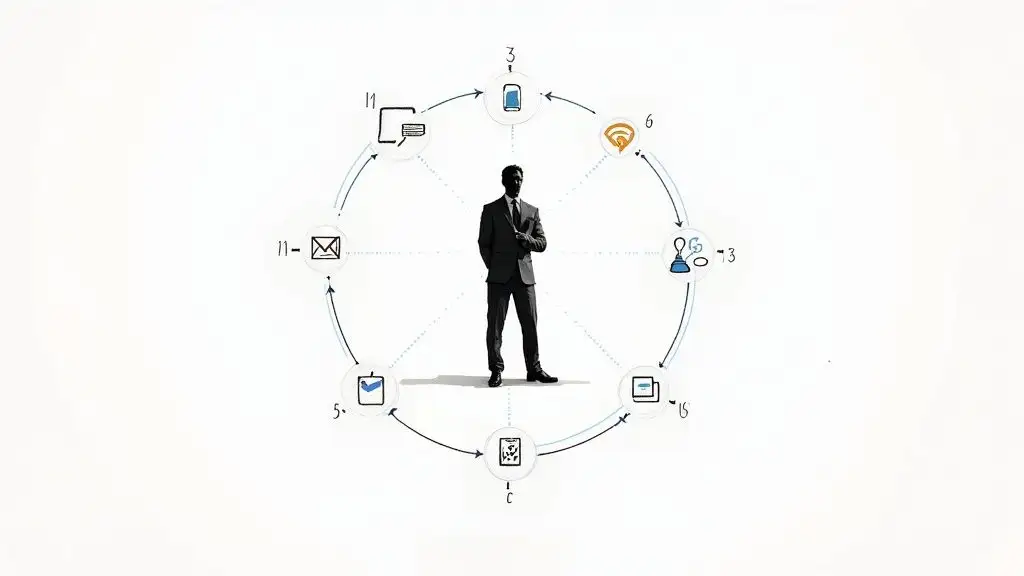
Relying solely on email for your sales outreach is like trying to win a race with one leg tied behind your back. It’s possible, but you’re making it much harder than it needs to be. The multi-channel cadence approach is a structured strategy that weaves together multiple communication channels, like email, phone calls, social media (think LinkedIn), and even SMS, into a single, coordinated sequence. This method significantly boosts touchpoint frequency and engagement by meeting prospects where they are most active.
Instead of sending five emails in a row, a salesperson systematically rotates through different mediums. This strategy maximizes visibility and makes your outreach feel more organic and less like automated spam. It’s a core component of modern sales cadence best practices because it respects the prospect's attention while ensuring your message gets through the noise.
Why It Works and How to Implement It
The logic is simple: different people prefer different channels. A CEO might ignore emails but respond to a concise LinkedIn InMail, while a director of operations might prefer a scheduled call. By diversifying your touchpoints, you increase the probability of connecting. For example, HubSpot has documented case studies showing a 30% higher conversion rate with multi-channel sequences.
To implement this effectively, map out a sequence that feels natural, not disjointed. A great multi-channel approach is foundational for a strong outbound lead generation strategy.
Actionable Tips for a Multi-Channel Cadence:
-
Structure Your Sequence: A proven sequence could be: Day 1: LinkedIn connection request + personalized email. Day 3: Follow-up email. Day 5: Cold call. Day 7: LinkedIn comment or message. Day 10: Final follow-up email.
-
Personalize for the Platform: Don't just copy and paste. Your LinkedIn message should be more conversational than your formal email. A phone call requires a different script entirely.
-
Space It Out: Avoid overwhelming prospects. Leave at least 2 to 3 days between touchpoints on different channels to prevent fatigue.
-
Test Your Mix: Use A/B testing to determine which channel combinations resonate most with your ideal customer profile (ICP). You might find that for a technical audience, email and LinkedIn work best, while for a sales audience, phone calls are more effective.
2. The Sequence-Based Cadence (Linear Outreach Flow)
Leaving your outreach to random acts of sales is a recipe for inconsistent results. The sequence-based cadence, also known as a linear outreach flow, is a structured, predetermined series of touchpoints spaced at strategic intervals over a 2 to 4 week period. It’s less like improv comedy and more like a well-rehearsed script, designed to guide a prospect through a predefined journey.
Each step in this sequence has a specific purpose that builds upon the previous interaction. You start with an introduction, then deliver your value proposition, follow up with social proof, and create a sense of urgency. This narrative-driven approach is a cornerstone of modern sales cadence best practices because it creates a logical and persuasive story that guides a prospect's decision-making process, moving them from unaware to interested.
Why It Works and How to Implement It
This method brings predictability and scalability to your outreach. By defining every step, you eliminate guesswork and ensure every prospect receives a consistent, high-quality experience. The data supports this structured approach: companies like SalesLoft have shown that reps using sequenced campaigns see up to three times higher engagement than those using ad-hoc methods. It’s the operational discipline popularized by pioneers like Aaron Ross in his Predictable Revenue methodology.
To implement this, you must map out the entire journey before you send the first email. The goal is to build momentum with each touchpoint, not just to check a box. This methodical flow ensures your messaging remains coherent and impactful from start to finish.
Actionable Tips for a Sequence-Based Cadence:
-
Map Your Narrative: Define the goal of each touchpoint. For example, Touch 1: Introduce the problem. Touch 2: Present your solution. Touch 3: Share a case study. Touch 4: Final call to action.
-
Include a Value-Add Resource: In every third touchpoint, include a helpful resource like a whitepaper, a blog post, or a short video. This builds goodwill and positions you as a helpful expert, not just a seller.
-
Build in a 'Pause' Option: If a prospect shows strong interest early on (e.g., books a meeting after your first email), have a system to automatically pause the sequence. Continuing to send automated follow-ups looks robotic and unprofessional.
-
Adjust Timing by Seniority: A C-level executive might need more space between touches (e.g., 4-5 days), while a manager might respond to a quicker cadence (e.g., 2-3 days). Tailor your timing to the prospect's role and industry norms.
3. The Response-Based Adaptive Cadence
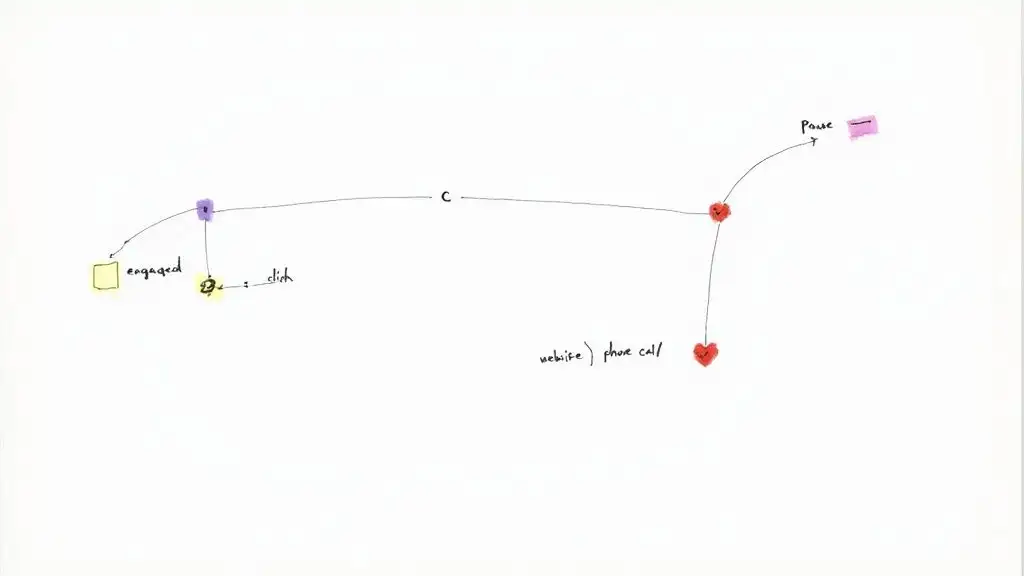
Following a rigid, one-size-fits-all sales cadence is like using a map from 1995 to navigate with a self-driving car. It’s functional, but it completely ignores the real-time data that could get you to your destination faster. The response-based adaptive cadence is a dynamic strategy that modifies the sales sequence based on a prospect's actual behavior, creating a personalized journey that reacts to their engagement.
Instead of blindly pushing a prospect through a fixed set of steps, this approach uses their actions—opening an email, clicking a link, or visiting your pricing page—as triggers to alter the next touchpoint. This is one of the most effective sales cadence best practices because it shifts the focus from a seller-centric schedule to a buyer-centric experience, ensuring your outreach is always relevant and timely.
Why It Works and How to Implement It
The logic behind this approach is that a prospect's engagement signals their level of interest. A cold lead who hasn't opened an email needs a different message than a warm lead who just watched your demo video. Platforms like ActiveCampaign have shown that behavioral-triggered automation can lead to 40% higher engagement because the follow-up is perfectly timed and context-aware. This method turns your sales cadence from a monologue into a conversation.
To implement this, you need to think like a chess player, planning several moves ahead based on your opponent’s actions. You define triggers and build parallel sequences that activate when a prospect meets specific criteria, ensuring no two journeys are exactly alike unless the prospects behave identically.
Actionable Tips for an Adaptive Cadence:
-
Define Engagement Triggers: Clearly identify what actions matter. Key triggers could include email opens, link clicks, website visits (especially to high-intent pages like pricing), or content downloads.
-
Create Parallel Cadences: Design at least two alternate paths. For example, have a "Low Engagement" path with nurturing content and a "High Engagement" path that immediately triggers a call from a sales rep.
-
Use Lead Scoring: Assign points to different actions to quantify interest. When a prospect reaches a certain score threshold, automatically move them into a more aggressive, high-touch cadence.
-
Implement Weekly Reviews: Analyze which triggers and paths are driving the most conversions. Don't be afraid to adjust your thresholds and messaging based on what the data tells you.
4. The Value-First Cadence Model
Pitching your product on the first touchpoint is the sales equivalent of asking someone to marry you on a first date. It’s too much, too soon, and it almost never works. The value-first cadence model flips the script entirely. It’s a consultative approach focused on delivering genuine insights and help before ever asking for a demo or a sale. Each touchpoint is designed to provide something useful, establishing you as a credible expert, not just another salesperson.
This strategy builds trust and positions you as a strategic partner. Instead of pushing a solution, you’re offering industry research, relevant case studies, or personalized recommendations based on the prospect's specific situation. This approach is one of the most effective sales cadence best practices because it warms up a cold outreach by proving your worth from the very first interaction.
Why It Works and How to Implement It
The core principle is reciprocity. By providing value upfront with no strings attached, you make prospects more receptive to hearing what you have to say later. This method, rooted in principles from The Challenger Sale, is about teaching, tailoring, and taking control of the conversation by leading with insight. Research from Gartner shows that this type of insight-led selling can drive 35% higher engagement rates because it directly addresses the prospect's world.
Implementing this requires a shift from a "what I'm selling" mindset to a "how I can help" mindset. It's a key element of modern sales prospecting best practices that focuses on building relationships.
Actionable Tips for a Value-First Cadence:
-
Do Your Homework: Before your first touch, research the prospect's company thoroughly. Look for recent news, earnings reports, or leadership changes you can reference to show you’ve done more than just scrape a name off a list. Pro tip: You can use Munch to automate the company research to get actionable points which can be used to craft personal outreach messages.
-
Share Relevant Benchmarks: Offer data or industry benchmarks that are directly relevant to their role or company goals. For example, "I noticed companies in your sector are struggling with X; here's a report on how leaders are tackling it."
-
Provide Personal Insights: Don't just forward a generic article. Add your own two-sentence summary explaining why you think it’s relevant to them specifically. Make it clear you've thought about their challenges.
-
Structure for Value: Your cadence could look like this: Day 1: Email with a personalized tip or observation. Day 4: LinkedIn message sharing a relevant case study. Day 7: Call to discuss a specific industry trend you mentioned earlier. Day 10: Final email with a comprehensive resource.
5. The Account-Based Sales (ABS) Cadence
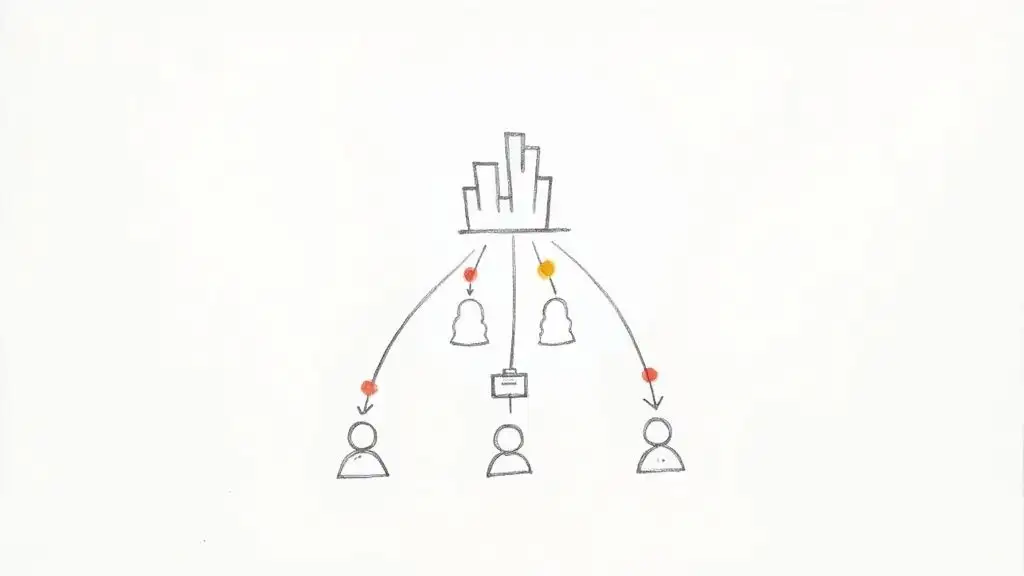
Targeting individual leads one by one is like trying to win a complex video game by only focusing on a single low-level enemy. You might get a small win, but you will miss the bigger picture. An Account-Based Sales (ABS) cadence flips the script by treating an entire company as the lead. It is a coordinated outreach strategy that targets multiple stakeholders within a single organization simultaneously.
Instead of a single linear sequence, an ABS approach involves running parallel cadences tailored to different decision-makers, like the CFO, the Head of IT, and the end-user. The goal is to build consensus and create internal momentum within the target account. This is one of the most powerful sales cadence best practices for complex, high-value deals because it acknowledges that B2B buying decisions are almost never made by one person alone.
Why It Works and How to Implement It
The logic behind ABS is that surrounding a buying committee with a consistent, value-driven message from multiple angles dramatically increases the odds of engagement. You create an "echo chamber" effect where different stakeholders start discussing your solution internally. Companies like 6sense and Demandbase have built their entire platforms around this methodology, proving its effectiveness in landing enterprise-level clients.
To implement this, you must move from a salesperson mindset to a strategist mindset, orchestrating a mini-campaign for each target account. It requires deep research and tight coordination across your sales team.
Actionable Tips for an ABS Cadence:
-
Map the Buying Committee: Before sending a single email, identify all key stakeholders. Use LinkedIn Sales Navigator and org chart tools to map out the decision-makers, champions, influencers, and blockers.
-
Develop Role-Specific Value Props: The CFO cares about ROI and TCO, while the IT Director is concerned with security and integration. Create unique messaging for each role that addresses their specific pain points and priorities.
-
Coordinate Touchpoint Timing: Orchestrate the timing of your outreach. For example, you might engage a potential champion on Day 1, then use their initial positive response as social proof when reaching out to their manager on Day 3.
-
Track Account-Level Engagement: Shift your primary success metric from individual response rates to overall account engagement. Are multiple people from the company visiting your website, opening emails, or connecting on LinkedIn? These are the signals that matter.
6. The Frequency-Optimized Cadence (Spacing & Timing Science)
Sending outreach without a plan for timing is like trying to binge-watch a series by hitting the "next episode" button randomly. You might eventually see it all, but the experience will be disjointed and confusing. The frequency-optimized cadence is a data-driven approach that uses historical performance and industry benchmarks to find the perfect rhythm for your touchpoints. It’s about finding the sweet spot between staying top-of-mind and becoming a persistent annoyance.
This scientific method analyzes how many touchpoints are needed and how far apart they should be spaced to maximize engagement. Instead of guessing, you’re using data to determine when to reach out and when to pull back. This strategy is a cornerstone of effective sales cadence best practices because it prevents prospect fatigue while ensuring your message has enough repetition to cut through the noise.
Why It Works and How to Implement It
The logic behind frequency optimization is rooted in human psychology and data analysis. Too few touchpoints and your prospect forgets you exist; too many, and you risk getting blocked. Sales engagement platforms have poured immense resources into figuring this out. For instance, research from Outreach.io consistently shows that sequences with 5 to 7 touches over a few weeks often hit the ideal balance for B2B engagement.
To implement this, you need to treat your cadence timing not as an art, but as a science experiment. Start with established benchmarks and then refine them based on your own audience’s behavior. The goal is to create a predictable, repeatable rhythm that warms up cold leads without burning them out.
Actionable Tips for a Frequency-Optimized Cadence:
-
Start with Benchmarks: Don't reinvent the wheel. Begin with proven models, such as spacing initial touchpoints 2 to 3 days apart, a timing HubSpot data suggests improves open rates.
-
Vary Timing by Engagement: If a prospect opens an email or clicks a link, accelerate your follow-up. If they are cold, maintain a slower, more deliberate pace.
-
Test Day and Time: Don't just send everything on Tuesday at 10 AM. A/B test different days of the week and times of day to see what works best for your specific ICP. You might find your C-level targets respond best after 4 PM.
-
Watch for Burnout: Monitor your unsubscribe rates and reply sentiment closely. A sudden spike in negative responses or unsubscribes is a clear signal that your frequency is too high.
7. The Objection-Based Cadence (Preemptive Response Strategy)
Most sales cadences are built to generate interest, but this one plays chess while others are playing checkers. Instead of waiting for a prospect to say, "it’s too expensive" or "we're already using a competitor," the objection-based cadence proactively dismantles these hurdles before they are even raised. This strategy involves designing each touchpoint to systematically address a common, anticipated objection, turning potential deal-breakers into reasons to engage.
This approach transforms your outreach from a simple pitch into a strategic consultation. Each email, call, or message builds a case by resolving concerns about price, implementation, competitive alternatives, or vendor risk. It’s a powerful element of advanced sales cadence best practices because it builds trust and demonstrates a deep understanding of the prospect's world, positioning you as a problem-solver from the very first interaction.
Why It Works and How to Implement It
The psychology here is powerful: by addressing objections preemptively, you remove friction from the decision-making process. Prospects feel understood, and their internal monologue of "but what about...?" is answered before they can voice it. This builds confidence and momentum. A B2B SaaS company, for example, might dedicate one touchpoint to a case study showcasing rapid ROI to counter price sensitivity, and another to a quick-start guide to ease implementation fears.
Implementing this requires deep insight into your buyer's journey and their most common hesitations. It’s about more than just selling a feature; it’s about selling a solution to their biggest anxieties. This thoughtful approach significantly improves your chances of securing a meeting with well-informed, less skeptical prospects.
Actionable Tips for an Objection-Based Cadence:
-
Identify Core Objections: Interview your sales team and analyze closed-lost deals to identify the top 3-5 objections you face. Common themes include price, timing, complexity, and satisfaction with the status quo.
-
Map Content to Objections: Create a specific piece of content for each objection. A customer testimonial video can counter "vendor risk," while a one-page ROI calculator can address price concerns.
-
Sequence the Solutions: Structure your cadence to tackle one objection per touchpoint. Start with the most common or impactful objection first. For instance, Day 1: Email with a case study on ROI (price). Day 4: LinkedIn message with a testimonial (trust). Day 7: Call to discuss a simplified implementation plan (complexity).
-
Test Your Messaging: A/B test your objection-handling messages against more traditional, benefit-focused outreach. Analyze which approach generates more positive replies and meetings booked with your target audience.
8. The Personalized Dynamic Cadence (AI and Intent Data-Driven)
Relying on a static, one-size-fits-all cadence is like giving every character in a video game the same generic dialogue. It gets the job done, but it’s completely uninspired and misses countless opportunities for deeper connection. The personalized dynamic cadence is an advanced strategy that leverages artificial intelligence and third-party intent data to tailor messaging, timing, and channel selection to each individual prospect’s real-time behavior.
This approach moves beyond simple persona-based segmentation. It uses buying signals, such as a prospect’s company suddenly researching your competitors or downloading a whitepaper on a relevant topic, to trigger and adjust the sales sequence. Instead of a fixed schedule, the cadence becomes a responsive, intelligent system that adapts the sales journey at scale, making it one of the most powerful sales cadence best practices for modern teams.
Why It Works and How to Implement It
The logic is rooted in relevance and timing. You engage a prospect not just because they fit your ideal customer profile, but because they are actively showing signs of being in-market right now. This significantly improves response rates by ensuring your outreach is timely and contextually aware.
To implement this, you must connect your sales engagement platform with robust data sources. This creates a feedback loop where intent signals automatically inform your cadence logic, making your outreach smarter and more efficient. Building this system is a key component of effective modern outbound sales strategies.
Actionable Tips for a Dynamic Cadence:
-
Audit Your Data Foundation: Start with a thorough data quality audit. AI-driven insights are only as good as the data they are built on. Ensure your CRM data is clean, accurate, and standardized.
-
Integrate Intent Data Sources: Implement intent data from 2-3 reputable sources to get a comprehensive view of buyer signals. Don’t rely on a single stream of information.
-
Combine AI with Human Insight: Use AI for what it does best: processing data and identifying patterns. But empower your reps to use their judgment to add the final layer of personalization and human connection.
-
Set Clear Success Metrics: Before launching, define what success looks like. Is it higher meeting book rates, shorter sales cycles, or larger deal sizes? Track these metrics rigorously to measure ROI and optimize your approach.
9. The Buyer Journey-Aligned Cadence (Stage-Specific Messaging)
Trying to push a demo on a prospect who just discovered your brand is like proposing on the first date. It’s too much, too soon, and it almost never works. A buyer journey-aligned cadence respects the natural progression of a relationship by tailoring messaging, content, and calls-to-action to the prospect's current stage: awareness, consideration, or decision. This method recognizes that a top-of-funnel lead needs education, not a hard sell.
This approach shifts the focus from your sales cycle to their buying process. Instead of a one-size-fits-all sequence, you create distinct cadences for each stage. It’s a core element of effective sales cadence best practices because it demonstrates empathy and provides genuine value, guiding prospects toward a solution rather than pushing them. This strategic nurturing significantly improves conversion rates by meeting buyers exactly where they are.
Why It Works and How to Implement It
The logic is rooted in relevance. A prospect in the awareness stage is asking "Why should I change?", while someone in the decision stage is asking "Why should I choose you?". Sending the wrong message at the wrong time creates friction and kills deals. By aligning your outreach, you become a helpful guide. Marketing automation leaders like Marketo and HubSpot have built entire platforms around this principle, proving its effectiveness in nurturing leads to a sales-ready state.
To implement this, you must first define clear triggers that move a prospect from one stage to the next. For example, downloading an introductory ebook might signal the "awareness" stage, while visiting your pricing page three times could indicate they've moved to "decision".
Actionable Tips for a Buyer Journey-Aligned Cadence:
-
Define Stage Triggers: Clearly map out what actions or engagement patterns signify each stage. Use lead scoring in your CRM to automate this process based on behaviors like website visits, content downloads, or webinar attendance.
-
Create Stage-Specific Content: Develop assets for each phase. An awareness cadence might share blog posts and industry reports. A consideration cadence could offer case studies and comparison guides. A decision stage cadence should provide demos, trials, and ROI calculators.
-
Adjust Your CTA: The call-to-action must match the stage. For awareness, ask them to subscribe to a newsletter. For consideration, invite them to a webinar. For decision, offer a personalized demo or consultation.
-
Review and Refine Quarterly: Buyer behavior changes. Re-evaluate your stage definitions, triggers, and content effectiveness at least once a quarter to ensure your cadence remains aligned with how your audience actually buys.
10. The Urgency and Social Proof Cadence (FOMO/SCARCITY Integration)
Waiting for a prospect to act can feel like waiting for dial-up internet to connect. It’s slow, painful, and often ends in disappointment. The Urgency and Social Proof Cadence is a strategy designed to break this inertia by strategically weaving psychological motivators like Fear Of Missing Out (FOMO), scarcity, and peer validation into your sequence. It transforms your outreach from a simple "checking in" message to a compelling reason to act now.
This approach isn't about high-pressure tactics or inventing deadlines. Instead, it’s about framing your value proposition within a context that encourages timely decision-making. By introducing elements like a limited-time offer, case studies from direct competitors, or mentioning industry trends, you provide a gentle yet persuasive nudge that helps prospects overcome analysis paralysis and move forward. This is one of the most powerful sales cadence best practices for accelerating deals in the later stages.
Why It Works and How to Implement It
Humans are wired to avoid loss and follow the herd. As Robert Cialdini detailed in his book Influence, scarcity and social proof are powerful persuasion principles. When prospects see that a resource is limited or that their peers are already benefiting, it creates an implicit value and an urgency to act. A SaaS company, for example, might see a significant lift in conversions by mentioning "only 3 onboarding slots left this quarter" to qualified prospects.
To implement this ethically and effectively, integrate these triggers into the middle and later stages of your cadence, after you’ve already established value. Starting with urgency is like asking someone to marry you on the first date: it’s just too much, too soon.
Actionable Tips for an Urgency and Social Proof Cadence:
-
Ensure Urgency is Genuine: Don't fabricate scarcity. Use real constraints like limited onboarding capacity, an upcoming price increase, or a beta program with a fixed number of seats. Authenticity is key to maintaining trust.
-
Combine with Value: Urgency without clear value feels manipulative. Frame your message around the benefit. For example: "I wanted to let you know our annual pricing ends this month, which would save your team 20% on the implementation."
-
Use Specific, Verifiable Social Proof: Vague claims like "our clients love us" are weak. Use specific testimonials, detailed case studies from similar companies, or G2/Capterra ratings to build credibility. Mentioning a prospect's competitor by name (if they are a client) is the ultimate social proof.
-
Apply FOMO Strategically: Save your most potent urgency triggers for later touchpoints (e.g., touch 6 of 8) when the prospect is engaged but hesitant. This is the final push, not the opening line.
Sales Cadence Best Practices — 10-Point Comparison
| Cadence Model | Implementation Complexity 🔄 | Resource & Speed ⚡ | Expected Outcomes 📊 | Key Advantages & Quality ⭐ | Ideal Use Cases 💡 |
|---|---|---|---|---|---|
| The Multi-Channel Cadence Approach | High — multi-channel orchestration, sequencing, CRM integration | High resources (tools + content + reps); moderate execution speed | Increased visibility; response ↑20–40%; lower unsubscribe risk | Broad reach; channel-preference matching; ⭐⭐⭐⭐ | Mid-market → enterprise outbound; prospects on varied platforms |
| The Sequence-Based Cadence (Linear Outreach Flow) | Medium — predefined linear workflow and automation | Low–moderate resources (templates + automation); steady cadence over 2–4 weeks | Consistent follow-up; scalable metrics; predictable engagement | Scalable and repeatable; removes guesswork; ⭐⭐⭐ | SDR teams, standard offers, scaling outreach |
| The Response-Based Adaptive Cadence | High — conditional flows, triggers, real-time monitoring | High (automation + monitoring); accelerates for engaged prospects | Better conversion (↑25–35%); less wasted effort; faster for engaged leads | Behavior-driven personalization and timing; ⭐⭐⭐⭐ | Data-rich programs, intent/behavior-based outreach |
| The Value-First Cadence Model | Medium — research and high-quality content creation required | Moderate–high (research + content); slower to pitch but builds trust | Higher open/response rates; more qualified leads; fewer objections | Establishes credibility and trust early; ⭐⭐⭐⭐ | Consultative sales, long-cycle enterprise deals |
| The Account-Based Sales (ABS) Cadence | Very high — stakeholder mapping and parallel orchestration | Very high (account research, cross-team coordination); can shorten cycles if done well | Higher close rates for enterprise; reduced deal risk; better forecasting | Multi-stakeholder alignment at account level; ⭐⭐⭐⭐⭐ | Strategic enterprise accounts, ABM/ABX programs |
| The Frequency-Optimized Cadence (Spacing & Timing Science) | Medium — requires analytics, A/B testing and continuous tuning | Moderate (analytics + testing); optimizes touch pacing for efficiency | Maximize response rates; lower unsubscribe; benchmark-driven improvements | Empirically optimized timing; data-backed decisions; ⭐⭐⭐⭐ | Data-driven teams, industries with clear timing patterns |
| The Objection-Based Cadence (Preemptive Response Strategy) | Medium — map common objections and craft targeted content | Moderate (research + tailored content); may speed progression by preempting barriers | Fewer live objections; improved close rates (↑15–25%) | Preemptive barrier removal; builds case progressively; ⭐⭐⭐ | Products with predictable objections (price, implementation) |
| The Personalized Dynamic Cadence (AI & Intent Data-Driven) | Very high — AI models, intent integrations, predictive scoring | Very high (tech, data infra); reaches prospects at optimal moments | Highest response and conversion; scalable one-to-one personalization | AI-driven personalization and timing; competitive advantage; ⭐⭐⭐⭐⭐ | Enterprise with budget for AI, high-volume intent signals |
| The Buyer Journey-Aligned Cadence (Stage-Specific Messaging) | Medium–high — stage detection and tailored content mapping | Moderate (tracking + stage-specific content); efficient use of sales time | More relevant engagement; better deal progression prediction | Stage-appropriate messaging increases relevance; ⭐⭐⭐⭐ | Lifecycle nurture, multi-stage buying processes |
| The Urgency and Social Proof Cadence (FOMO/Scarcity) | Low–medium — craft authentic urgency and social proof placements | Low–moderate resources; can rapidly accelerate decisions | Short-term response lift (↑30–50%); faster closes but potential quality trade-offs | Powerful psychological triggers when authentic; use cautiously; ⭐⭐⭐ | Late-stage prospects, limited offers, promotional pushes |
Bringing It All Together: Orchestrating Your Winning Cadence
We have journeyed through ten distinct blueprints for creating high-impact sales cadences, from the foundational Multi-Channel approach to the sophisticated, AI-driven Personalized Dynamic Cadence. You now have a strategic playbook filled with actionable models designed to break through the noise and capture your prospect's attention. But the real masterstroke, the secret to truly dominant outbound, is not in rigidly adhering to a single model. It is in the artful synthesis of these strategies.
Think of it less like following a recipe and more like being a master chef. You do not just use salt; you combine it with herbs and spices to create a unique flavor profile. Similarly, the most effective sales teams blend these cadence concepts into a cohesive, powerful outreach engine. They recognize that the best approach is rarely singular; it is a meticulously orchestrated sequence of strategic actions.
From Blueprint to Performance: Key Takeaways
The core lesson from these sales cadence best practices is that modern selling requires a fluid, intelligent, and deeply human-centric approach. Gone are the days of "spray and pray" outreach. Success today is built on a foundation of empathy, data, and relentless optimization.
Here are the most critical takeaways to carry forward:
-
Hybridization is King: The most potent cadences are hybrids. An Account-Based Sales (ABS) cadence becomes exponentially more effective when you integrate the Value-First model and optimize it with Frequency-Optimized timing. A Sequence-Based Cadence can be elevated by layering in principles from the Objection-Based Cadence to proactively address concerns.
-
Personalization is Non-Negotiable: Generic outreach is the fastest way to the trash folder. Leveraging intent data, social proof, and AI-driven insights to tailor every single touchpoint is what separates top performers from the rest. Prospects expect you to understand their context, their challenges, and their journey.
-
Data is Your North Star: You cannot improve what you do not measure. A/B testing your messaging, tracking engagement metrics across different channels, and analyzing response rates are not just "nice to have" activities. They are the engine of continuous improvement that keeps your cadences relevant and effective.
The ultimate goal is to create a system where every touchpoint feels less like a sales pitch and more like a helpful, timely conversation. This is the essence of mastering sales cadence best practices.
Your Actionable Next Steps
Feeling inspired is one thing; taking action is what generates pipeline. To translate the knowledge in this guide into tangible results, start here:
-
Audit Your Current Cadence: Pull up your existing sequences. Which model do they most closely resemble? Where are the gaps? Are you truly multi-channel, or just sending a series of similar emails? Be brutally honest about what is working and what is not.
-
Identify One Hybrid to Test: Do not try to boil the ocean. Select one promising combination to pilot. For example, try enhancing your current linear sequence by aligning it with the Buyer Journey-Aligned Cadence. Create distinct messaging for awareness, consideration, and decision stages.
-
Integrate One New Data Source: Start incorporating a new layer of intelligence. This could be mobilizing intent signals to prioritize accounts showing buying behavior or using a tool to generate personalized icebreakers based on a prospect's recent LinkedIn activity.
-
Commit to a Testing Cadence: Ironically, you need a cadence for testing your cadences. Commit to running one A/B test per month, whether it is on a subject line, a call-to-action, or the timing between touches.
Mastering your sales cadence is a transformational investment. It is the framework that turns strategy into execution, enabling your team to build a predictable, scalable revenue engine. By moving beyond rigid templates and embracing a dynamic, data-informed, and value-driven methodology, you are not just sending better outreach; you are building stronger relationships and fundamentally changing the way you connect with future customers.
Ready to put these advanced sales cadence best practices into action? Munch is the AI-powered platform that helps you identify high-intent buyers and automate the creation of hyper-personalized outreach needed to execute these strategies at scale. Stop guessing and start engaging the right prospects with the right message by exploring what Munch can do for your team.