A Sales Territory Plan That Actually Works

By Mriganka Bhuyan
•Founder at Munch
A sales territory plan is just a fancy way of saying you have a smart system for dividing up your market and handing out assignments to your sales team. The whole point is to squeeze every last drop of potential out of your market, making sure every rep has a fair shake and every prospect gets the right kind of attention.
Why Most Sales Territory Plans Are a Hot Mess
Let's be real for a second. Most so-called "plans" are nothing more than a dusty spreadsheet someone made three years ago or a map with some lines scribbled on it after a triple shot espresso. They look official, but they do absolutely nothing to stop the chaos on the ground.
A real, strategic sales territory plan? That's your secret weapon for creating predictable, scalable growth. It's the difference between your team running a perfectly executed play and a bunch of individuals just chasing after shiny objects.

When there's no clear strategy, your team is flying blind, operating on gut feelings and old assumptions. And that leads to some pretty painful and predictable problems.
The Hidden Costs of Just "Winging It"
When territories are a jumbled mess, reps either drown in a sea of low-quality leads or starve for a single decent opportunity. Your top performers get completely burned out carrying everyone else, while the rest of the team disengages because their patch is a barren wasteland. It's the perfect recipe for high turnover and a sea of red on the quota board.
A poorly designed sales territory plan doesn't just crush morale; it's practically rolling out the red carpet for your competitors to swoop in and grab the prime accounts your team is too disorganized to handle.
All that chaos means you're leaving a ton of money on the table. We’re not talking chump change, either. Companies that actually put in the work to build a strategic plan see 15% higher revenue, a 20% jump in sales productivity, and spend a staggering 75% less time on planning than teams using ad hoc methods.
The Payoff of a Real Strategy
A well-crafted plan flips the script, moving your team from constantly reacting to proactively hunting. You create a system where every rep knows exactly which accounts are theirs, what their goals are, and how their individual hustle fits into the company's grand vision.
Here’s what you get:
-
Sky-High Sales Productivity: Reps stop wasting time figuring out who to call and spend more time actually selling. Clear boundaries put an end to turf wars and the classic "Hey, I thought that was my lead!" arguments.
-
Airtight Customer Coverage: You can finally sleep at night knowing no high-potential accounts are slipping through the cracks. The plan guarantees that every single one of your Ideal Customer Profiles (ICPs) gets consistent, focused attention.
-
Fair, Balanced, and Motivating Workloads: By divvying up opportunities with data instead of just drawing lines on a map, you create an environment where every rep has a realistic shot at crushing their number. That’s a game-changer for morale and retention.
Building an effective plan is a huge first step, but it's only half the battle. To truly make the most of your shiny new territories, you also need to know how to qualify sales leads. After all, a perfect territory is useless if your reps are chasing duds.
Laying The Foundation For Your Sales Territory Plan
Before you start drawing lines on a map like you’re planning the heist in Ocean’s Eleven, you need to know what you’re trying to steal. Seriously. Kicking off a sales territory plan without clear goals is like starting a road trip with no destination. You'll burn a lot of fuel and probably end up lost in a cornfield somewhere.
First thing's first: define your objectives with surgical precision. Vague goals like "increase sales" are completely useless. They don't give your team a real target to aim for. You need specific, measurable, achievable, relevant, and time-bound (SMART) goals to anchor your entire strategy.
So, what game are you actually playing this year?
-
Hunting for New Logos? If so, your plan will zero in on territories with a high density of untapped prospects that look exactly like your best customers.
-
Breaking into a New Industry? You might create specialized territories for reps who have that niche expertise, even if it means throwing traditional geographic lines out the window.
-
Growing Wallet Share? The focus here shifts to territories where your existing customer base is strong, assigning reps who are masters at farming and upselling.
From Vague Wishes to Specific Missions
A weak objective sounds like, "We want to sell more in the Midwest." That's the business equivalent of telling your GPS "just drive west." It’s not helpful.
A strong, actionable objective is a different beast entirely.
Example: "Our goal is to increase new enterprise logo acquisition in the Midwest fintech sector by 25% over the next two quarters, targeting companies with over $50 million in annual revenue."
This goal tells you exactly who to target (enterprise fintech), where to look (the Midwest), what winning looks like (25% growth), and the deadline (two quarters). Now you have the building blocks for a real sales territory plan.
Digging for Data Gold in Your CRM
With a clear objective locked in, your next stop is the CRM. It's not just a digital rolodex; it’s a treasure trove of historical data that can help predict future success. Don't get lost in vanity metrics. Instead, focus on the data points that will directly shape your territory design.
Key data inputs to get your hands on include:
-
Historical Sales Figures Per Region: Where have you won before? This is a dead giveaway for where you have product-market fit and brand recognition.
-
Deal Velocity by Segment: How long does it take to close a deal with an SMB versus an enterprise client? This is crucial for balancing workloads. A rep with a territory full of long-cycle enterprise deals needs fewer accounts than one stacked with quick-turn SMBs.
-
Customer Lifetime Value (LTV): Which types of customers stick around and spend the most over time? You'll want to prioritize territories packed with these high-LTV lookalikes.
Getting into this data helps you move from gut feelings to a data-driven strategy. You might discover that while California brings in the most revenue, your win rate in Texas is twice as high and the sales cycle is 30% shorter. That insight is pure gold. Once you've identified these high-potential areas, sharpening your strategy for outbound lead generation becomes the critical next step to capitalize on the opportunity.
Sharpening Your Ideal Customer Profile
Your Ideal Customer Profile (ICP) is the final piece of this foundational puzzle. Far too many companies are running on a fuzzy, outdated persona. "We sell to marketing managers" isn't an ICP; it's a lazy assumption.
A truly effective sales territory plan is built on a hyper-specific ICP. You need to know the firmographics, technographics, and even the buying signals that define your perfect future customer.
Let's see what this looks like in practice.
-
Vague Persona: "We target B2B SaaS companies."
-
Specific ICP: "B2B SaaS companies headquartered in North America with 200-1,000 employees, using HubSpot and Salesforce, that have recently hired a new VP of Sales in the last 90 days."
See the difference? The first is a wish; the second is a battle plan. This level of detail lets you pinpoint high-potential accounts with incredible accuracy. Now you can actually build territories around clusters of these ideal customers, ensuring your reps spend their time fishing in a stocked pond, not an empty one.
Pro Tip: Using a tool like Munch can help you build prospect lists instantly using powerful filters including different geographies among others. This can help you build lists for different sales teams quickly.
How To Design Territories That Are Fair, Not Equal
Let's get one thing straight: creating sales territories isn't about cutting a pizza into perfectly equal slices. It’s about making sure everyone at the table gets a slice they can actually eat. The goal is equity, not equality. Handing a rookie rep a territory loaded with your most complex, high-maintenance accounts is a recipe for disaster, while a veteran would probably crush it.
The secret to a killer sales territory plan is balancing opportunity, not just geography or account count.
This is exactly where so many sales leaders stumble. They pull up a map, draw a few neat lines, and call it a day. What they’ve actually done is create a Hunger Games scenario for their sales team. One rep gets the Capitol, overflowing with juicy prospects, while another is stuck in District 12 with nothing but cold leads. This guarantees two things: your star players will burn out, and everyone else will get disillusioned. Fast.
A truly effective plan designs territories that are fair by balancing potential. It’s about giving every single rep a realistic shot at hitting their number, which, let's be honest, is the only motivator that really matters.
Choosing Your Territory Segmentation Model
So, how do you do it? First, you need to pick a segmentation model that actually fits your strategy. It’s like picking your character in a video game; the right choice depends entirely on the level you're about to play.
The table below breaks down the most common models. You'll probably find that a mix-and-match approach works best.
| Segmentation Model | Best For | Example Scenario | Potential Pitfall |
|---|---|---|---|
| Geographic | Teams with heavy field sales presence where travel time is a killer. | A logistics company carving up territories based on major shipping corridors to maximize client visits. | Ignores massive differences in account potential within a single region. "The entire Southeast" is not a strategy. |
| Account-Based | Laser-focusing on a specific list of high-value, named accounts. | A cybersecurity firm gives one rep a curated list of 100 Fortune 500 targets to penetrate, turning them into a deep specialist. | Can create "all or nothing" pressure. If those key accounts don't bite, the rep has nowhere else to turn. |
| Industry/Vertical | When deep industry knowledge is your competitive advantage. | A med-tech company has a rep who only calls on hospitals and clinics. They speak the language, know the pain points, and build trust faster. | Reps may miss cross-industry opportunities or become too siloed in their knowledge base. |
| Hybrid | Most B2B SaaS and tech companies looking for a balanced approach. | A rep is assigned "all enterprise manufacturing accounts east of the Mississippi." This combines geography, account size, and industry. | Can be more complex to set up and manage initially, but the payoff in focus and efficiency is huge. |
The right model isn't just a tactical choice; it's a strategic one. A hybrid model is often the sweet spot, giving you the focus of a vertical strategy with the practical boundaries of geography.
This flowchart can help you visualize how to connect your business goals to the right segmentation strategy.
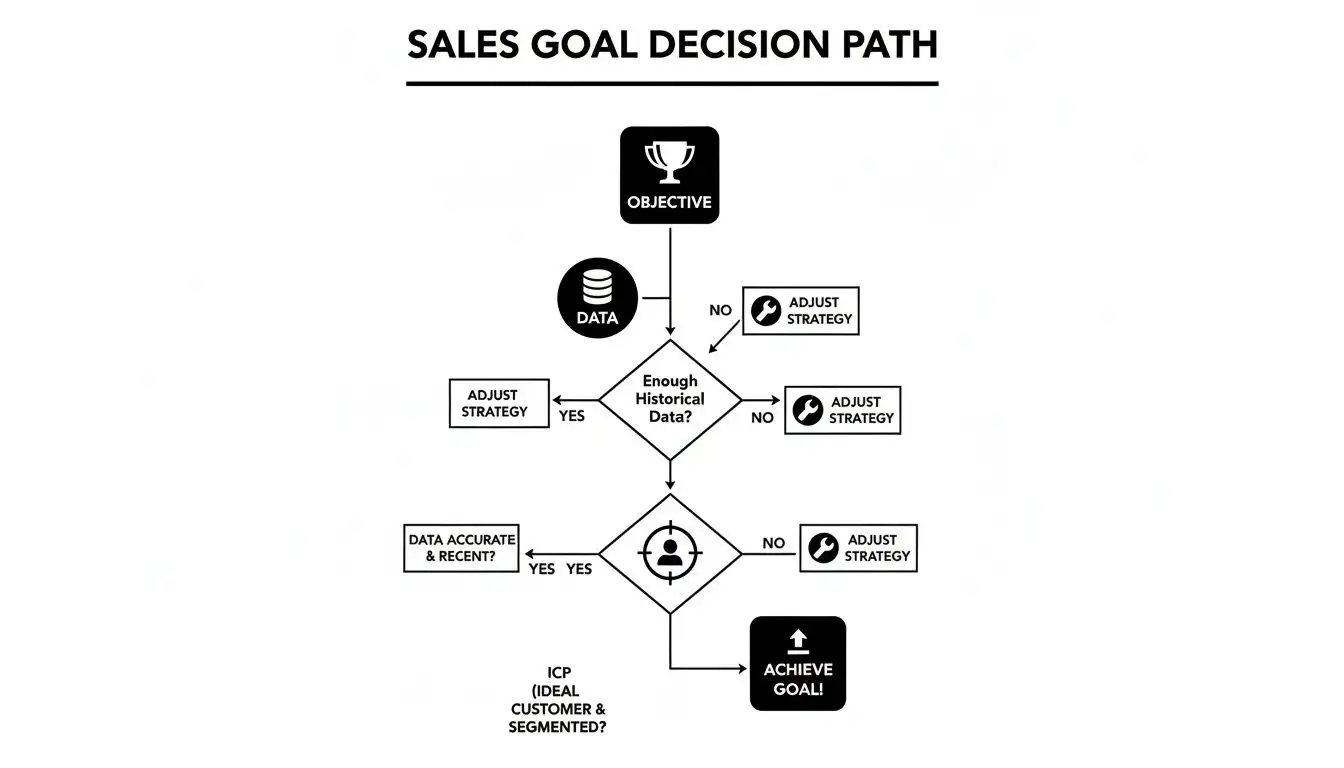
As you can see, the path always starts with your core objectives and a crystal-clear picture of your ideal customer. Don't skip that part.
The Golden Rule of Workload Balance
Once you’ve picked your model, the real work begins: balancing the workload. And I don't just mean the number of accounts. A territory with 50 high-potential, enterprise-level whales could be just as much work as a territory with 300 smaller SMB accounts that have a much shorter sales cycle. You have to factor in the effort.
To get this right, you need to score your accounts. A simple scoring model can make all the difference. We dive deep into this in our guide on lead scoring best practices, but the core idea is to rank accounts based on factors like potential deal size, industry fit, and recent buying signals.
This data-driven approach lets you distribute opportunities far more equitably. Instead of just giving each rep 100 accounts, you give them territories with a similar total potential score.
The magic number: +/-10%. Aim to keep the total workload potential within a 10% variance across all territories. This one rule will silence 99% of the "my patch sucks" complaints before they even start because you have the data to prove the opportunities are balanced.
When your team sees that the territories are demonstrably fair, you build trust and create a culture where everyone feels they have a real shot at winning. Your sales territory plan transforms from a simple map into your most powerful tool for motivation and performance.
Giving Your Team the Right Tech and a Clear Playbook
Let's be real. A beautifully designed sales territory plan is just a pretty map without the right tech and clear rules. It's like giving your team a treasure map from The Goonies but writing it in a dead language. Cool idea, but totally useless. This is where the rubber meets the road and where your brilliant strategy gets operationalized.
Putting your plan into action is so much more than just tweaking a field in your CRM. The right tech stack is the central nervous system for your territories. It automates the mind-numbing stuff and frees up your reps to do what you pay them for: selling.
This means looking beyond your CRM and embracing tools that give your team an almost unfair advantage. I'm talking about sales intelligence platforms that sniff out opportunities and automation software to handle the tedious job of lead routing.
Assembling Your Tech Stack
Your CRM is the foundation, sure, but it's not the whole building. To really bring your sales territory plan to life, you need a few more key pieces. The goal isn’t to duct-tape together a Frankenstein's monster of software, but to build a streamlined system where every tool has a clear, defined purpose.
Here’s what a modern, effective stack actually looks like:
-
Sales Intelligence Tools: Think of these as your secret weapon. They help you find high-intent prospects within each patch by scanning for buying signals like job changes, fresh funding rounds, and new tech adoption. This turns a static territory list into a dynamic hunting ground. We may be biased but we think Munch does an incredible job at this!
-
Routing & Automation Platforms: This is how you enforce your territory rules without hiring a full-time traffic cop. These tools instantly assign new leads and accounts to the right rep based on the logic you’ve already set up, whether it's by geography, industry, or company size.
-
Sales Engagement Software: Once an account is assigned, this is what helps reps execute their outreach at scale. It ensures consistent follow-up and gives you a clear picture of which territories are generating the most engagement.
Picture this: a new inbound lead comes in from a manufacturing company in Ohio. Your routing software instantly checks its location and industry, sees it belongs to Sarah's territory, and assigns it to her in the CRM. At the same time, your sales intelligence tool enriches the lead with fresh contact info and juicy company details. Sarah gets a notification, and that prospect is already dropped into her sales engagement sequence, all within minutes. It feels like magic, but it’s just smart automation. To see what’s possible, you can dive deeper into the different types of AI sales tools that can power these workflows.
Creating Your Rules of Engagement
A killer tech stack without clear rules is like giving a toddler an iPad with no parental controls. It's going to get messy, fast. Your "Rules of Engagement" (ROE) document is the constitution for your sales team. It’s a simple, no-nonsense guide that prevents reps from stepping on each other's toes and cuts out 90% of territory squabbles before they even start.
Think of it as the unwritten rules of a 90s sitcom, but for your sales team. Everyone knows their role, what’s off-limits, and how to handle those awkward situations. Your ROE should be a living document, easily accessible to everyone.
Your Rules of Engagement document isn't about restricting your reps; it's about liberating them. When the rules are clear, reps can stop worrying about territory conflicts and focus all their energy on closing deals.
Here's a quick checklist of scenarios your ROE absolutely must cover:
-
Inbound Lead Ownership: How are website demos, content downloads, and contact requests handled? Is it a round-robin within the territory, or does it go to an existing account owner if there is one?
-
The "Moving Headquarters" Problem: What happens when an account moves its main office from one territory to another? Does the original rep keep it, or is it handed off? A common fix is to give the original rep a grace period (say, two quarters) before a formal handoff.
-
Handling National & Global Accounts: Who owns a monster account like Walmart, with offices everywhere? Typically, a named account manager gets the headquarters, but the ROE has to define how they’ll collaborate with local reps working with regional offices.
-
Statute of Limitations: How long can a rep sit on an account without any meaningful activity before it’s fair game for someone else? A clear "use it or lose it" timeframe (like 90 days of no logged activity) keeps the pipeline from getting stale.
By getting these rules down on paper, you turn potential shouting matches into simple procedural questions. The result? A happier, more productive sales floor where the only competition is against quota, not each other.
How to Roll Out and Refine Your Master Plan
So, you’ve done the hard work. You’ve crunched the numbers, mapped the segments, and cooked up a sales territory plan that’s a thing of beauty. But a plan gathering dust in a PowerPoint deck is just a theory. The rollout is where your strategic masterpiece meets reality, and trust me, it shouldn’t feel like a dramatic season finale of Succession. A clumsy launch can torpedo even the most brilliant plan.
The secret to a smooth landing? Communication. Simple as that. Don't spring the new territories on your team like a surprise pop quiz. You need to frame the changes as an opportunity, not a threat. Use all that juicy data you gathered to show them why the plan is changing and how it creates a fairer, more lucrative playing field for everyone.
Getting The Team On Board
Transparency is your best friend here. The very first question from every single rep will be, "What's in it for me?" You'd better be ready with an answer grounded in hard data. Show them how the new structure balances workloads and cracks open fresh opportunities, ultimately making it easier for them to not just hit, but crush, their quota.
I’ve found that preparing a simple rollout package for each rep works wonders. Think of it as their personal playbook.
-
A Clear Territory Overview: A clean one-pager showing their specific accounts, geographic lines, and industry focus. No ambiguity.
-
The "Why" Explained: A quick summary of the data that shaped their new territory, highlighting its potential. Sell the vision.
-
Updated Rules of Engagement: A link to the ROE document so they know exactly how to handle any weird edge cases from day one.
When you present the plan, you’re not a manager handing down orders from on high. You're a coach explaining the new game plan. Emphasize that this new sales territory plan is designed to put every single player in a position to score.
Tracking The Metrics That Actually Matter
Once the plan goes live, it's time to measure its pulse. But drowning yourself in a sea of metrics is a rookie mistake. Instead, laser-focus on a handful of key performance indicators (KPIs) that give you a clear signal on whether the territories are actually working.
Your sales territory plan isn't a stone tablet handed down from the mountain. It's a living document, a dynamic strategy that must adapt to the market. Treat it as such.
For each territory, start by keeping a close eye on these essentials:
-
Quota Attainment Rate: This is the ultimate pass-fail test. Are reps consistently hitting their numbers? If a whole group of reps is missing quota, the problem might be the plan, not the people.
-
Lead Conversion Rate: This tells you if the right leads are getting to the right reps. If conversion rates suddenly tank in a specific territory, it could mean the rep is struggling with the new segment or the lead quality is garbage.
-
Pipeline Coverage Ratio: A healthy territory should have a pipeline value that is 3-4x its quota. A low ratio is an early warning sign that a rep is failing to build momentum in their new patch.
-
Average Sales Cycle Length: Are deals closing faster or taking forever? A sudden jump in sales cycle length might signal a mismatch between a rep’s skills and their territory’s needs.
Tracking these numbers gives you the objective data you need to make smart adjustments. By also monitoring site traffic and conversion goals, you can see if marketing is actually driving qualified leads into the right territories. If you need a refresher, check out this excellent guide on how to track website visitors effectively.
Establishing a Rhythm for Reviews
The biggest mistake leaders make is treating their sales territory plan as a "set it and forget it" project. The market zigs, competitors zag, and your team evolves. A plan that was perfect in January can be completely obsolete by July. Ditch the chaotic, once-a-year fire drill and establish a regular review cadence instead.
A quarterly review is the sweet spot for most B2B teams. This lets you make agile adjustments without causing constant whiplash and disruption. These reviews aren't witch hunts; they're strategic check-ins to make sure the plan is still tethered to reality.
During these sessions, ask the tough questions:
-
Are some territories consistently blowing past quota while others lag behind? That’s a blaring signal that a rebalance is needed.
-
Have new market opportunities popped up that we didn't account for?
-
Are workloads still balanced, or has growth in certain areas created a new class of haves and have-nots?
Smart territory design is proven to deliver some serious results. Companies can see a revenue uplift of up to 15% and productivity gains of 20% just by creating balanced plans that factor in variables like deal size and market maturity. It’s worth the effort to get this right and keep it right.
Got Questions About Sales Territory Plans? We've Got Answers.
Alright, you've got the roadmap and a pile of data. But let's be real, the real headaches start when you try to put it all into practice. Here are some quick answers to the questions that pop up most often when you're trying to nail down your sales territories.
How Often Should We Update Our Sales Territory Plan?
The old "set it and forget it" annual plan is a fossil. The market just moves way too fast for that. A much better rhythm is a deep-dive review once a year, with lighter quarterly check-ins. This lets you adapt to market shifts or weird performance trends without sending your entire team into a tailspin.
Think of the quarterly check-in as a pit stop in a race. The annual review? That's when you take the whole car apart and rebuild the engine.
Some things just can't wait for a scheduled review. You need to revisit the plan immediately if you're:
Launching a major new product.
Cracking into a totally new market or industry.
Making big team changes, like adding a new sales pod or losing a top rep.
If you wait a full year to react to any of those, you’re leaving money on the table. Simple as that.
What's The Best Way To Handle Account Overlap?
Ah, the classic sales territory turf war. It's the "two Spider-Men pointing at each other" meme, but with commissions on the line. The only way out is to create a crystal-clear "Rules of Engagement" document before the conflict happens. Don't wait for two reps to start duking it out in a Slack channel over a hot lead.
Here are a few proven systems to choose from; just pick one and make it law:
-
First Meaningful Touch: Whoever logs the first real activity, not just a blind email, gets the account. This rewards hustle.
-
Named Account Lists: Your enterprise or senior reps get a protected list of high-value targets. That's their sandbox, no questions asked.
-
Geographic HQ: Ownership is based on the company's official headquarters address. It’s clean and objective, but can be a bit inflexible.
Whichever you land on, write it down, tell everyone, and make sure a sales manager has the final say when things get messy.
How Do I Get Reps To Buy Into A New Plan?
Whatever you do, don't just drop a new territory plan on your team like a surprise test. The secret sauce is transparency and involvement. If your reps feel like the plan is being done to them instead of for them, they'll fight it, even if it’s a work of art.
Pull a few of your senior, most respected reps into the planning process early on. Their street-level feedback is gold, and they'll become your champions when it's time to roll it out to everyone else.
When you finally present the new map, don't just show them the lines. Walk them through the "why" behind the changes. Use your data to show them how this new setup is designed to be more balanced and give everyone a better shot at crushing their quota. Remember to frame it in a way they care about: "This plan is built to help you make more money."
Ready to stop guessing and start targeting? Munch is the sales intelligence platform that helps you find high-intent prospects within any territory, enrich their data, and launch personalized outreach that actually gets replies. Turn your perfect plan into a powerful pipeline at Munch.