What Is a Bounced Email and How Do You Stop Them?

By Mriganka Bhuyan
•Founder at Munch

You know that feeling? You craft the perfect outreach email, hit "send," and wait for the magic to happen. But instead of a reply, you get a cold, automated rejection notice. Ugh.
That, my friend, is a bounced email. It’s the digital equivalent of a "return to sender" stamp, and it’s a critical signal you can’t afford to ignore. Understanding why your emails bounce is the first step toward protecting your sender reputation and making sure your hard work actually pays off.
Your Email Bounced, Now What?

So, you got a bounce notification. Don't panic. This is a common hurdle in email outreach, but how you handle it makes all the difference for your sales pipeline and, more importantly, your sending reputation.
A bounced email simply means your message couldn't be delivered. But here’s the key: not all bounces are created equal. They fall into two distinct camps, hard bounces and soft bounces, and knowing the difference is what separates the pros from the spammers.
Hard Bounces: The Permanent Roadblocks
A hard bounce is a full-stop, permanent delivery failure. Think of it like trying to page someone on their beeper in 2024. The address is gone, the technology is obsolete, and it’s never, ever going to arrive.
These happen for a few very clear reasons:
-
Invalid Email Address: The most common culprit. The address flat-out doesn't exist. Maybe it's a typo (
jane.doe@gamil.com), or maybe Jane left her job and the company deleted her account. -
Domain Doesn't Exist: You're trying to email someone at
acme-corp.com, but that domain name has expired or never existed in the first place. -
Server Rejection: The recipient's email server has decided it doesn't want to hear from you and has blocked delivery permanently.
When an email hard bounces, the only correct action is to remove that address from your list immediately. Seriously. Don't try sending again. Repeated attempts to contact a dead address scream "spammer" to providers like Gmail and Outlook, and they will tank your sender reputation faster than you can say "blacklist."
Soft Bounces: The Temporary Glitches
A soft bounce is a temporary hiccup. The email address is real and valid, but something got in the way of delivery right now. You just need to try again later. Understanding the timing and logic of your sales automation process is key to managing these retries without annoying the servers.
Common causes for a soft bounce include:
-
The recipient’s inbox is completely full.
-
Their email server is down for maintenance or just overloaded.
-
Your email, with that massive attachment, is too large for them to accept.
These issues often fix themselves. The inbox gets cleaned out, the server comes back online. But keep an eye on them. If an address consistently soft bounces over several campaigns, it might be a sign of a deeper problem, and it could eventually turn into a hard bounce.
Hard Bounce vs Soft Bounce at a Glance
To make it even clearer, here’s a quick cheat sheet comparing the two types of bounces. Think of this as your go-to guide for diagnosing a delivery failure.
| Attribute | Hard Bounce | Soft Bounce |
|---|---|---|
| Cause | Permanent issue (invalid address, bad domain) | Temporary issue (full inbox, server offline) |
| Severity | High. Damages sender reputation. | Low to Moderate. Usually resolves itself. |
| Recipient Status | The email address is invalid and unusable. | The email address is valid, just unavailable. |
| Immediate Action | Remove the address from your list. Immediately. | Monitor. Retry sending a few times. |
Understanding this distinction is fundamental. Hard bounces require immediate cleanup, while soft bounces call for a bit of patience and strategic re-trying. Get this right, and you're already way ahead of the game.
The Two Types of Bounces: Hard vs. Soft
So, not all bounces are created equal. To get a handle on them, you need to know the difference between the two main culprits. Think of it like this: one is a brick wall, and the other is just a temporary detour.
Getting this distinction right is everything. One tells you to stop immediately, while the other suggests trying again later. Messing them up can wreck your sender reputation.
Hard Bounces: The Permanent "Return to Sender"
A hard bounce is a full-stop, permanent delivery failure. It’s the email server on the other end telling you, "This address is a ghost. It doesn't exist. Stop trying." There's no coming back from this one.
The reasons behind a hard bounce are usually straightforward and final.
-
Invalid Email Address: This is the big one. Maybe you made a typo (
prospect@gmial.com), or the person left the company and their account was deleted. The address is simply no good. -
Nonexistent Domain: You're trying to send an email to a domain that’s gone poof. The company might have shut down, rebranded, or just let their domain expire.
-
Server Rejection: The receiving server has blacklisted you. It’s looked at your domain or IP address and decided it doesn't want anything to do with you, ever.
A hard bounce is a clear and final signal. Ignoring it and continuing to email that address is one of the fastest ways to get your domain flagged as spam. Do it too often, and you'll find all your carefully crafted emails landing in the junk folder.
Soft Bounces: The Temporary Glitches
A soft bounce is way less dramatic. This is a temporary hiccup, not a permanent rejection. The email address is valid, the person exists, but something went wrong at the exact moment you hit send.
Think of these as short-term problems that usually sort themselves out.
-
Full Mailbox: The most classic example. Your prospect’s inbox is crammed to the gills and literally can’t accept another message until they clean it out.
-
Server Is Down or Offline: The recipient's email server is taking a coffee break. It might be down for maintenance, overloaded, or just having a bad day.
-
Message Size Is Too Large: You tried to send a file the size of a small car. Your email, with its beefy attachment, is just too big for the recipient’s server to handle.
A one-off soft bounce is no big deal; most email service providers will even try to send it again automatically. But you’ve got to keep an eye on them. If the same address soft bounces over and over again, it's likely an abandoned inbox that's on its way to becoming a hard bounce.
The rule of thumb? Ditch an address after 3–5 consecutive soft bounces. While a bounce rate under 2% is the industry benchmark for "good," staying on top of it is what separates the pros from the spammers. With over 376 billion messages flying around the internet daily, even a tiny percentage of bounces adds up to a mountain of missed opportunities. You can dig into more of these email blast statistics from Verified Email’s research.
Pro Tip: Use Munch to not only find emails of your leads but also to validate and verify them to reduce bounces!
Why Bounced Emails Are a Big Deal
So, you’ve got a high bounce rate. Is it really a big deal? Absolutely. A high bounce rate isn't just a number to glance over in a report; it’s a massive, flashing red light for your entire email game.
Think of ISPs like Gmail and Outlook as the bouncers at the most exclusive club in town: Club Inbox. If you keep trying to get people in who aren't on the list (those are your hard bounces), the bouncers quickly figure out you’re trouble.
Suddenly, you’re not just a sender. You’re a suspicious sender. This is where your sender reputation enters the scene. It’s basically the credit score ISPs assign to your domain, and they use it to decide if your future emails get past the velvet rope or are unceremoniously tossed into the spam folder out back.
The Downward Spiral of a Bad Reputation
Once your sender reputation takes a hit, it triggers a vicious cycle. ISPs like Google and Microsoft see your high bounce rate and start either slowing down your email delivery (throttling) or just filtering you more aggressively. This means even your perfectly crafted emails to totally valid prospects might never see the light of day.
It's a cascading disaster for every metric you care about:
-
Lower Deliverability: Fewer emails even make it to an inbox in the first place.
-
Tanking Open Rates: Pretty hard to open an email you never received.
-
Reduced Click-Throughs: No opens mean zero clicks on your brilliant call-to-action.
-
Shrinking Sales Pipeline: It all leads here. Fewer conversations get started, and your pipeline starts to look like a desert.
This isn't just some abstract concept; it’s a real operational problem. Major mailbox providers are on record saying they use bounce patterns to judge senders. A bounce rate consistently creeping over 5% is a huge red flag that tells them you aren’t managing your lists. This kind of scrutiny leads to more aggressive filtering or, worse, getting blocked entirely. With email still delivering a crazy ROI, protecting your ability to land in the inbox by managing bounces is directly tied to your revenue. If you want to dive into the numbers, there are some great email marketing statistics from Constant Contact that paint the full picture.
From Bounces to Blacklists
Ignoring bounces is like driving your car while the "check engine" light is on. You might get away with it for a bit, but eventually, you're going to break down on the side of the road. If your bounce rate stays high, you’re running a serious risk of getting your sending IP address or entire domain put on an email blacklist.
Getting on a blacklist is the email equivalent of having your picture posted in the post office. It's a public announcement that you're an untrustworthy sender, and tons of ISPs use these lists to block mail automatically. Trust me, getting off one is a long, painful headache.
This is why you have to understand what is a bounced email and, more importantly, do something about it. Every hard bounce you scrub from your list and every soft bounce you investigate is a small investment in your sender reputation. It's the essential engine maintenance that keeps your outreach running smoothly and ensures your messages actually land where they’re supposed to. The whole game starts with a clean contact list, which is why it’s so critical to know how to qualify sales leads before you even think about hitting "send."
Decoding Common Bounce Messages and Codes
When an email bounces, it doesn't just vanish into the digital ether. It sends back a cryptic little message, a bounce code, that often feels like it was written by a hacker in a 90s movie. But learning to read these codes is like getting a secret decoder ring for your email outreach; you can suddenly see exactly what's going wrong.
You don’t need to be a network engineer to crack the code. It’s all about recognizing the patterns. Bounce codes fall into two main camps, which conveniently line up with the hard and soft bounces we've already talked about.
Codes in the 400 range (like 421 or 451) are basically the server saying, "Not right now." They signal a temporary problem, making them a soft bounce. On the other hand, codes in the 500 range (like 550 or 553) are a permanent failure, a hard bounce.
Translating the Tech Speak
Think of a 400-level code as a "please try again later" sign on a shop door. The server might be too busy, the mailbox might be temporarily full, or it's just having a bad day. A 500-level code, however, is a boarded-up window with a "business closed" sign. The server is telling you the address is fake, the user doesn't exist, or you're flat-out blocked.
This distinction is everything. It tells you whether your ESP should try again automatically or if you need to scrub that contact from your list for good.
As this shows, it's a simple fork in the road. High bounces lead directly to a damaged sender reputation, which torpedoes your ability to land in anyone's inbox.
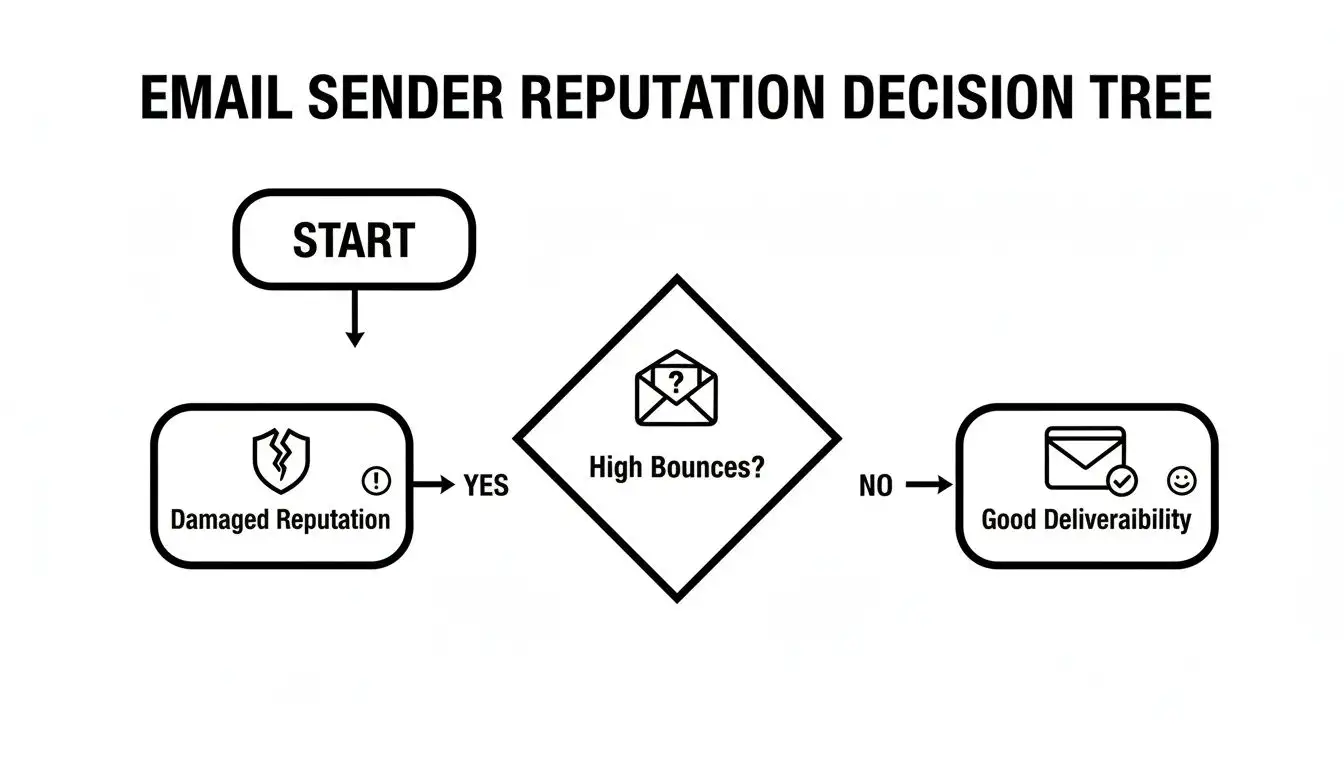
Ultimately, how you handle bounces is one of the biggest factors determining whether you maintain great deliverability or destroy your reputation.
To help you out, I’ve put together a quick cheat sheet for the most common codes you’ll see in the wild, translated from geek-speak into plain English.
Understanding the difference between a 4XX and 5XX error code is the first step to turning a failed delivery into actionable intelligence. One is a temporary setback, the other is a permanent roadblock.
Common SMTP Bounce Codes Translated
Trying to make sense of your bounce report can feel like reading a foreign language. This table cuts through the noise and tells you what each common code actually means and what you need to do about it.
| SMTP Code | What It Means (Plain English) | Recommended Action |
|---|---|---|
| 550 User Unknown | The email address doesn't exist. This is the most common hard bounce. | Immediately remove the contact from your list. This address is a dead end. |
| 421 Service Not Available | The recipient's server is temporarily offline or too busy to accept your email. | This is a soft bounce. Your email service provider should automatically retry sending later. |
| 552 Mailbox Full | Your contact is the digital equivalent of a hoarder. Their inbox is over its storage limit. | Treat as a soft bounce. Monitor it; if it keeps happening, the inbox may be abandoned. |
| 554 Message Rejected | The server blocked your email, often due to failing authentication checks or being on a blacklist. | Investigate your sender reputation and authentication settings (SPF/DKIM) immediately. |
Think of these codes not as failures, but as feedback. The recipient's server is giving you valuable intel you can use to clean up your lists and sharpen your outreach strategy. Acting on it is what separates the pros from the spammers.
Actionable Steps to Reduce and Prevent Bounces
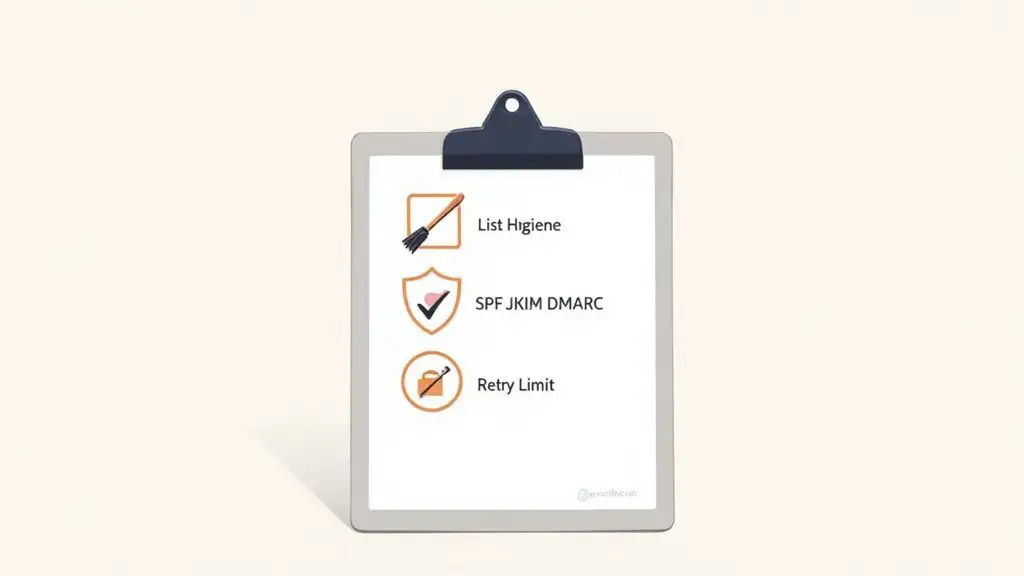
Alright, enough theory. Knowing what a bounced email is doesn't help if you can't stop it from happening. So, let’s get tactical and build a bounce-proof email strategy.
Think of this as your training montage for awesome email deliverability. It’s time to get your lists in fighting shape.
The most critical habit you can build is practicing good list hygiene. It's just a fancy term for keeping your contact list clean and current. People change jobs, companies rebrand, and old domains die; data gets stale faster than you think. Regularly scrubbing your list of inactive or invalid contacts isn’t optional; it’s essential.
Practice Proactive List Hygiene
Don't sit around waiting for your bounce rate to skyrocket before you clean house. Getting ahead of the problem is the only way to win this game long-term.
-
Verify Before You Send: Get in the habit of using an email verification service to check new contacts before you ever hit "send." These tools can ping a server to see if an address is real without sending a full email, saving your reputation from a ton of preventable hard bounces. Just use Munch to verify emails!
-
Clean Your List Regularly: Make it a ritual. At a bare minimum, run your entire contact list through a verification service every quarter. If you're a high-volume sales team, doing it monthly is even better.
-
Implement a Sunset Policy: Let’s be real. If a contact hasn't opened or clicked one of your emails in six months, they're just not that into you. Set up a rule to automatically remove these disengaged subscribers. It keeps your list lean, mean, and effective.
The goal of list hygiene isn't just to dodge bounces; it's to focus your energy on people who actually want to hear from you. It’s like the KonMari method for your CRM: if a contact doesn't spark joy (or a reply), thank them for their time and let them go.
Authenticate Your Domain Like a VIP
Next up: you need to prove you are who you say you are. This is where email authentication protocols like SPF, DKIM, and DMARC come in. Think of them as your official ID, backstage pass, and security detail all rolled into one. They’re a clear signal to ISPs that your emails are legit and not some phishing scam trying to sneak past the velvet rope.
Starting in 2025, major providers like Outlook are making these mandatory for anyone sending a lot of emails. Fail to set them up, and your messages will get sent straight to junk or flat-out rejected. Getting these records configured correctly is one of the most powerful things you can do to build trust with receiving servers. For a deeper dive, check out our guide on how to improve email deliverability, which breaks this down in more detail.
Manage Soft Bounces Intelligently
Finally, you need a smart plan for those pesky soft bounces. Since they're temporary, it's easy to just ignore them, but that's a huge mistake. An address that keeps soft bouncing is often a canary in the coal mine, a sign of an abandoned inbox.
Set a clear retry limit. Most email platforms will automatically try sending again a few times, but you need your own house rule. Here's a good one: if an address soft bounces three to five consecutive times, it's time to cut it loose. This stops a nagging problem from slowly poisoning your sender reputation. It's the email equivalent of knowing when to fold 'em; don't keep knocking on a door that’s never going to open.
How Verified Data Helps Sales Teams Dodge Bounces
For any sales team, a bounced email isn't just a failed delivery notice. It's a dead end. A conversation that never happened, time down the drain, and another small hit to your sender reputation.
Think of it as showing up for a huge meeting only to find out the office building was torn down last year. That’s exactly what happens when you’re working with bad data. This is where high-quality, verified data completely changes the game.
Instead of rolling the dice on a stale, sketchy list, you're starting with contact information that’s already been checked and confirmed. Using a service that provides verified data is like having a secret cheat code for your entire outreach strategy. It stops those reputation-killing hard bounces before you even hit "send."
Ultimately, this proactive approach means your team spends way less time sifting through bounce notifications and more time actually talking to real, interested people. Better deliverability directly fuels a healthier sales pipeline.
The Real-World Cost of Dirty Data
Slashing your bounce rate isn't just about good digital etiquette; it's about money. The impact on your bottom line is real and measurable. With hundreds of billions of emails flying around the globe every single day, even a tiny improvement can make a massive difference.
Let's run some numbers. Say your company sends 10 million emails. If you can drop your bounce rate from a pretty standard 2.3% down to just 1.0%, that’s 130,000 more messages that actually land where they're supposed to. For a large sender, that represents thousands of dollars in opportunities that didn't just vanish into the ether. You can dig into more stats on the most important email marketing statistics from Inboxally to see the full picture.
Here's a fun way to think about it: sending emails to an unverified list is like being a contestant on Wipeout. You're guaranteed to hit a lot of ridiculous obstacles, and your odds of actually reaching the finish line (the inbox) are pretty dismal. Verified data is your clear, straight shot to victory.
It all boils down to efficiency and revenue. Fewer bounces mean a stronger sender reputation, which leads to better inbox placement for all your future campaigns. This ensures your hard work actually gets seen, sparking more conversations and booking more meetings. Plus, clean data is the foundation for your entire revenue engine, a key point we cover in our guide to lead scoring best practices.
Bounced Email FAQs: The Nitty-Gritty
Let's tackle some of the most common questions that pop up about bounced emails. Consider this your rapid-fire guide to solving bounce-related headaches and making sure you’re sending emails that actually land.
What’s a Good Email Bounce Rate, Anyway?
While every industry is a little different, aiming for a bounce rate under 2% is a solid goal. That’s what a healthy, well-maintained list looks like. The real pros? They often keep it below 0.5%.
Now, if your bounce rate starts creeping above 5%, it’s time to sound the alarm. That's not just a small problem; it's a giant, flashing neon sign telling Internet Service Providers (ISPs) that something is wrong with your sending practices. They'll notice, and your sender reputation will take a hit.
Can a Soft Bounce Become a Hard Bounce?
You bet it can. Think about it this way: someone leaves their job. For the first week, their inbox is just full, a classic soft bounce. But a month later, the IT department officially deletes that email address. Poof. It's gone forever.
The next time you try to email that contact, what was once a temporary soft bounce has now become a permanent hard bounce. This is exactly why you need a system to automatically remove contacts that soft bounce multiple times. Don't be the one still trying to deliver mail to a vacant lot.
How Often Should I Scrub My Email List?
There isn’t one perfect answer for everyone, but a good rule of thumb is to put your entire list through a verification tool at least twice a year.
Are you a high-volume sender? Or a sales team whose prospect data changes faster than fashion trends? In that case, cleaning your list quarterly is a much safer bet. The goal is to make list hygiene a routine, not an emergency measure you only take when your deliverability is already in the gutter. It’s a core part of the best practices for cold email campaigns.
Stop gambling on outdated data and start closing more deals. Munch provides 95%+ accurate, verified contact information so your team can focus on selling, not on decoding bounce notifications. Find your next customer today.